
Image Credit: Aidan Hubley
For May Term 2023, I joined a team of professors and students from Messiah University and Harrisburg University of Science and Technology and traveled to Greece. While we were there, we expected to gain exposure to a few archaeology skills, such as drone surveying, photogrammetry, and artifact illustration. Our focus was a refugee settlement called Washingtonia. This community was created by an American, Samuel Gridley Howe, in 1829, in collaboration with Governor Ioannis Kapodistrias following the Greek War for Independence. Howe believed that by establishing a farming community on the Corinthian Isthmus, he could provide the Greek families displaced by the war with homes, food, and a clear pathway to self-sustainability. This interesting episode of American influence in Greece has long piqued the curiosity of archaeologists and cultural historians, but over the years, the exact location of the former colony was lost. During our time in Greece we were able to pinpoint the location of many important buildings in the colony’s early life, finally providing some closure to this evasive archaeological puzzle.
Now, our team moves into the next phase of preparing our research for public presentation. We plan to present our findings at the Annual Meeting of the Archaeological Institute of America this coming January. There are three components to this presentation. First, Dr. David Pettegrew will serve as lead author for a paper detailing the archaeological research conducted and the discovery of the location of key structures in the Washingtonia colony. Fellow student researcher Keli Ganey and I will serve as co-authors alongside Professors Kostis Kourelis, Albert Sarvis, and Nikos Poulopoulos. My contribution to the paper will highlight the experiences of student researchers who traveled to Greece this past May and participated in the discovery process. The second component of the presentation is a video documentary of Washingtonia and our work in reconstructing its location. This project will be led by Keli Ganey.
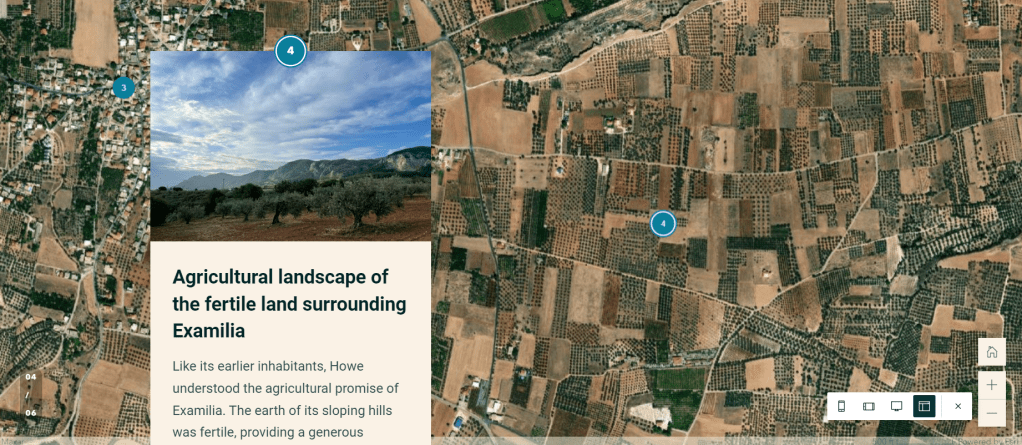
I’m taking the lead on the third and final element of our presentation. Back in May, I served as one of many student writers for a digital collection of stories about Washingtonia and our work there. Now I am tasked with editing this collection, adding additional material we’ve processed, and refining the narrative we want to tell. These stories take the form of an ArcGIS Story Maps Collection, a feature of Story Maps that allows for the grouping of various digital stories under one site. Each story includes text, images, and video in a sidecar alongside an interactive map of the area, connecting the text with specific places. This platform works really well for our presentation because it will provide a coherent space to showcase the photo and video data we collected while in Greece and present a compelling narrative about a colony many are unfamiliar with. Currently, we’ve planned four distinct stories for our Collection: the background to and founding of Washingtonia; the growth of the colony; the aftermath; and the archaeological rediscovery in the twenty-first century.
My main focus at this stage in the project is to provide rich context to Washingtonia and the history of humanitarian projects in Greece after the war. Washingtonia, after all, did not exist in a vacuum, and Howe was not a lone “hero” figure for the refugees. Many countries, including France, Germany, and Russia sent food, and artillery to Greece during and after the war. Each country had a slightly different motivation than the others, but all were concerned about which European power would exert influence over Greece with the Ottomans removed. European humanitarian involvement is just one of the many themes that illustrates the complexity of life in nineteenth-century Greece, themes which situate Washingtonia in a larger sociopolitical context. Through highlighting these complexities in the Story Map, I hope to add depth to the public-facing component of our presentation, prompting further reflection and research when we share our findings in January.
An excerpt of the abstract for the paper to be presented in January can be found below:
In 1829, the American philanthropist Samuel G. Howe founded a colony on the Isthmus of Corinth to house refugees displaced by the Greek War of Independence. Through the support of Governor Ioannis Kapodistrias, land grants from the new Hellenic state, and financial aid raised in the United States, Howe restored the Ottoman infrastructure in the region, oversaw farm operations, and supervised the building of a school and hospital. He returned to the United States and reached national recognition in the education of the blind and the abolition of slavery. By the time the American excavations of Corinth commenced in 1896, Washingtonia had all but disappeared from memory of the Corinthian landscape.
James Wiseman brought Washingtonia to the attention of archaeologists again in his Land of the Ancient Corinthians (1978), identifying the site with the modern village of Examilia. The senior staff of the Eastern Korinthia Archaeological Survey (1997–2003) were naturally interested in locating the colony because of the project’s commitment to the archaeology of the modern period. Yet the settlement’s location evaded archaeologists because written accounts indicated different, sometimes contradictory, scenarios about its whereabouts.
In this paper, we report on our rediscovery of the major elements of this unique colony at the transition between the late Ottoman and early modern periods. Making use of historical maps and aerial photos, primary documents, drone photography, oral histories, and architectural study, we used mobile devices and the ArcGIS Field Map app to identify Washingtonia’s distinct landmarks. Especially helpful was a digitized draft version of a map found in the National Archives of France made by the geographer Pierre Peytier during his cartographic work for the Scientific Expedition of the Morea. Our project showpieces new strategies in digital archaeology that can lead to productive models of pedagogy and public archaeology.
For additional background, be sure to check out these articles from Dr. Kostis Kourelis on Washingtonia and its place in the broader context of refugees in Greece: https://kourelis.blogspot.com/2016/09/washingtonia_19.html https://kourelis.blogspot.com/2016/09/finding-washingtonia.html
Alex Shehigian is a senior at Messiah University. She is majoring in public history and minoring in digital public humanities. She is also an Archives Office Assistant at the Messiah University Archives and volunteers with the Walt Whitman Birthplace Association archives. You can learn more about her here.
 Digital Harrisburg
Thanks for sharing
Continued Success!
Joe Bedard
CRLC
717.579.6889