
I never saw myself as someone who was that good at using technology. Certainly, I didn’t feel qualified to take on the task of digital history with my skills in technology. However, through my experience as a Public Humanities Fellows Student and after taking a Cybersecurity class, I felt like I could finally take on the task of digital history.
Currently I am working towards creating a website that will discuss the speech Mira Lloyd Dock provided to the Harrisburg Board of Trade in 1900 which propelled the “City Beautiful Movement” in Harrisburg within my project. Accordingly, I have spent most of my time in the archives trying to research Mira Lloyd Dock and her initial speech. My project will dive into what the process of establishing “City Beautiful” was like and how Mira Lloyd Dock’s travels to Europe may have influenced her interest in the “City Beautiful Movement.” My goal with this project is to inform the public about Mira Lloyd Dock’s involvement and preparation for improving sanitation and greenery in Harrisburg.
While I was in the Pennsylvania State Archives, I chose to primarily look throughout the letters that she had been sending to friends, family, and the American Forestry Association. This could all be found in the Dock, Mira Lloyd Family Papers collection. While at the State Archives I chose to have my items digitized with a CZUR scanner (Image 1, below). This scanner captured amazing images of the letters I was looking at, but there were so many students and only one scanner at the State Archives, so I did have to use my phone to scan pictures with my phone’s camera text scanner and a tripod like device to keep my phone balanced above my sources. There is something about holding a primary source that feels like tissue paper in one’s own hands that feels so bewildering. It is like going to a museum and being allowed to finally touch an artifact on display, except in this case I am hunting for the artifact, and I am allowed to touch the artifacts.
While at the Pennsylvania State Archives I found a wonderful series of letters between Mira Lloyd Dock and the American Forestry Association. Eugene S. Wilson had originally sent a letter to Mira Lloyd Dock requesting that she back his decision in charging people for a monthly magazine titled “Forestry & Irrigation” and paying Mira Lloyd Dock a part of this sum. Well Mira Lloyd Dock’s response truly reflects her strong-willed personality, and I loved it. She was firm and she demanded an apology from Eugene S. Wilson for even recommending that they charge the members of the association for their magazine. What Wilson was asking Dock to do went against the oath she had taken as she was not meant to create a profit from her work, nor did she want to create a profit. [1] Therefore, she felt it was necessary to call out the audacity of Wilson for attempting to make a profit off of the members of the Association.
While I was in the Historical Society of Dauphin County Archives I chose to look primarily for photographs that could be useful in visualizing the change that was brought about by Mira Lloyd Dock and to help the reader get a sense of what Mira Lloyd Dock looked like through pamphlets and print photographs. These were found in the City of Harrisburg collection, individual images of Mira Lloyd Dock, and an image titled “Trolley Car/Decorated with City Beautiful Signs” (Image 2, below, which is fitting for this election day!). While I was at the Dauphin County Archives, I could really feel the time crunch. My eyes had to be on the end goal of my project the entire time.
Unfortunately, the main collections I wanted to access for my project were inaccessible as they were too heavy for the archivist, and they had no machine that would allow me to access the old formatting of the photographs I wanted to look at. This really connects with Adam Crymble’s book Technology and the Historian as he discusses how historians must recognize that sustainability and planning are key to preserving archives.[2] Especially online if the materials are difficult to move around or are difficult to access with modern technology. My project could have benefitted from having the collection I wanted to look at being transcribed and digitized into their online database. However, I did get an image of an advertisement on a trolley car which was immensely helpful.[3] I used my phone and Adobe Scan to scan my items which allowed for the best pictures I could have gotten from my phone.
All in all, my visit to both the Pennsylvania State Archives and the Historical Society of Dauphin County Archives were both significantly more successful than I could have imagined. Despite the work being incredibly difficult in trying to find sources and then digitizing said sources, I found it helpful to view and hold the sources in person. Being in person with documents that are so precious is an astonishing experience. Just knowing that I have digitized sources that no one else has seen online is fascinating to me as I never would have imagined that I would be capable of digitizing documents for my own website.
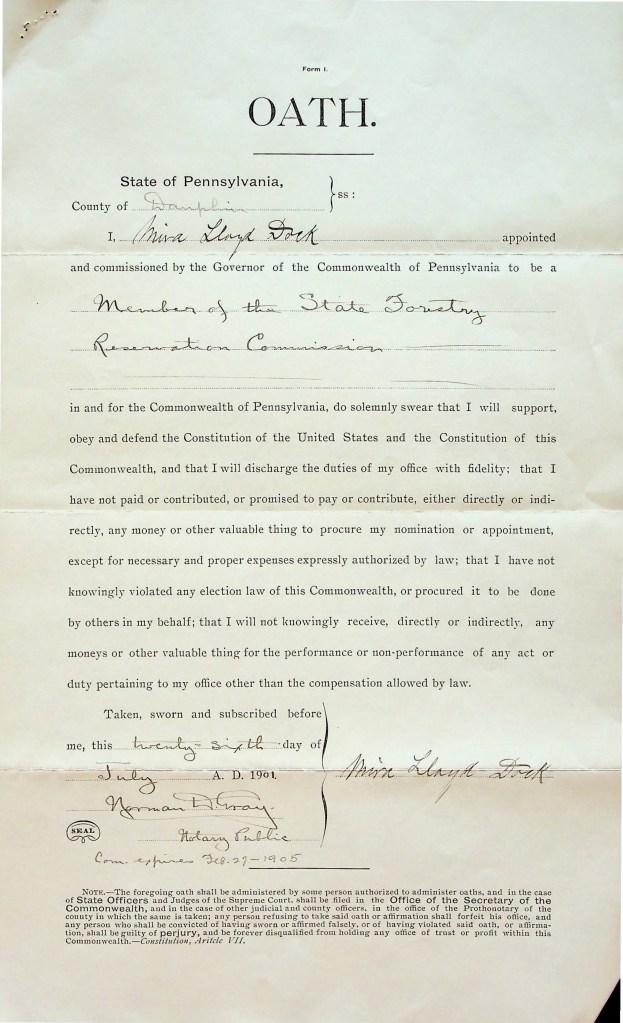
Image 1 Pennsylvania State Archives MG043, Box 43.2, “Correspondence, Appointment to Forestry Commission, plus Oath, 1901.”
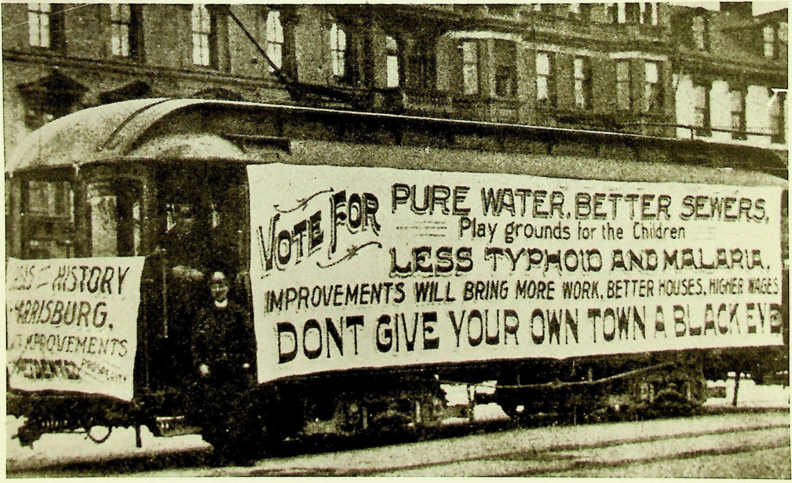
Image 2 Historical Society of Dauphin County Archives MG-229-1331, Box 1, “Trolley Car/Decorated with City Beautiful Signs.”
Bibliography
Crymble, Adam. Technology and the Historian: Transformations in the Digital Age. Chicago:
University of Illinois Press, 2021.
[1] Image 1
[2] Adam Crymble, Technology and the Historian: Transformations in the Digital Age (Chicago: University of Illinois Press, 2021), 62.
[3] Image 2
Phoebe Lemin is a senior public history major with an art history minor.
 Digital Harrisburg