
Yesterday marked a significant milestone in our ongoing efforts to make the rich history of Pennsylvania’s capital region more accessible to the public. After two years of dedicated work by students, faculty, and community partners, Messiah University’s Center for Public Humanities officially launched Harrisburg Historical, a free website and mobile app that brings to life the diverse stories and significant places of the greater Harrisburg area.
We created Harrisburg Historical as a digital space to tell the many histories of Pennsylvania’s Capital Region. Built on Curatescape, a digital platform created by Cleveland State University’s Center for Public History + Digital Humanities, Harrisburg Historical uses placed-based historical storytelling offering users an innovative way to explore local history through interactive maps, carefully researched stories, and rich multimedia content. At the heart of Harrisburg Historical is a collection of stories that connect significant places with the people who shaped, transformed, and gave them meaning. We offer stories in three formats: 1) concise “Post-its” of around 100 words that flag key locations and direct visitors to additional resources and which we may one day develop into longer essays; 2) “Briefs” of approximately 500 words that provide short, focused narratives; and 3) “Historical Essays” of about 1,000 words that offer in-depth exploration of significant places and events. Each story is enriched with historic and present-day images, primary sources, secondary resources, and bibliography (linked to Zotero), with some featuring audio and video clips to create an immersive experience.
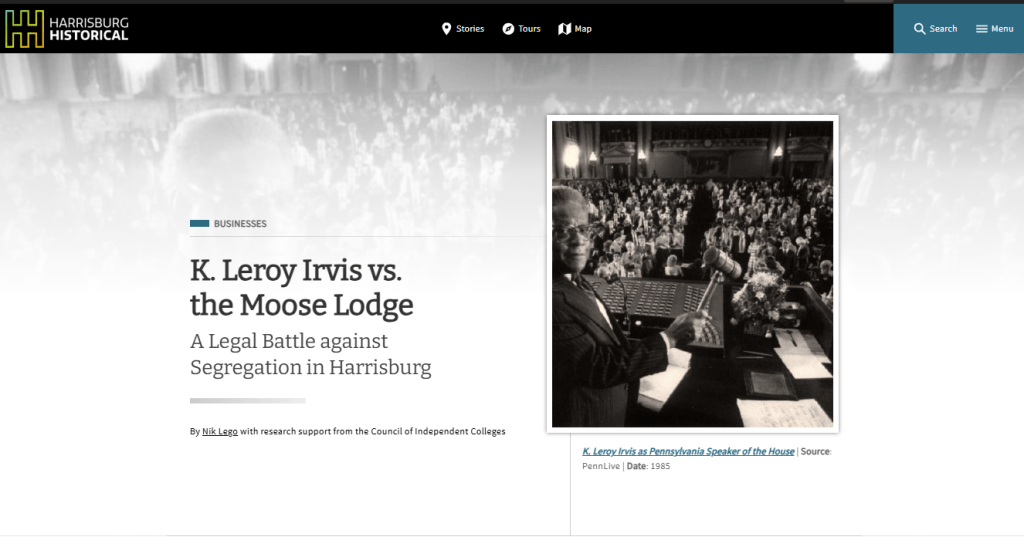
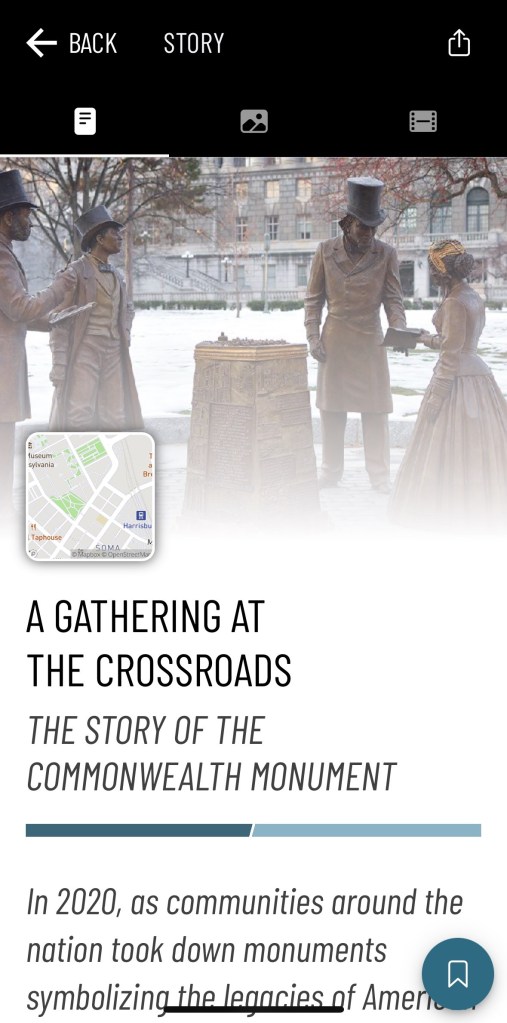
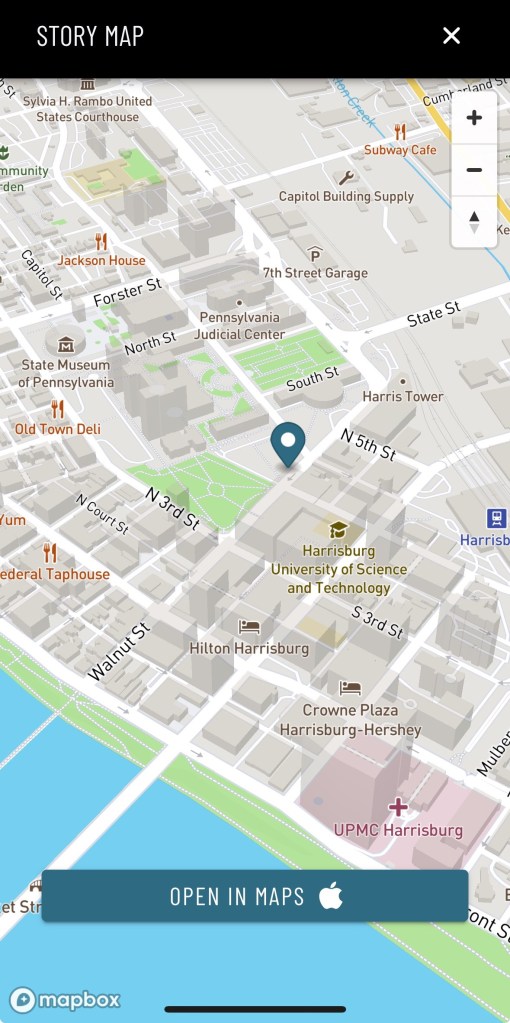
Besides the individual story, Harrisburg Historical also allows the visitor/user to explore thematic tours based on a collection of stories. You may choose to explore a tour virtually through your computer or mobile device, or experience it in person by enabling location services in the app to guide you through the historic sites. While we designed some tours especially for virtual exploration and others especially for walking, all are accessible in either format.
Our centerpiece tour included with this launch is “The Chester Way: Harrisburg’s Centuries Long Quest for Civil Rights.” Named after Thomas Morris Chester (1834-1892), the United States’ first Black war correspondent and a prominent Harrisburg civil rights advocate, the tour exemplifies the project’s commitment to illuminating the Capital Region’s crucial role in the long struggle for racial justice and equality in our nation. The tour is organized chronologically and spans an impressive range, from Colonial times—the 1720s story of John Harris’s rescue by an enslaved man named Hercules—to the 2020 unveiling of the Pennsylvania Commonwealth Monument, which celebrates the passage of the Fifteenth and Nineteenth Amendments and honors the achievements of Harrisburg’s Black community. By following significant stories of race and place in the Capital Region, the reader will encounter the “Chester way” as a legacy of faithful individuals advocating for freedom, suffrage, justice, rights, and opportunities for all.

Complementing the full Chester Way tour are two additional tour experiences: “The Chester Way Walking Tour of the Capitol Complex” and “The Old Eighth Ward: The Vanished Neighborhood of the Pennsylvania State Capitol.” History major Jake Kocher (class of 2025) developed the Capitol Complex Walking Tour in fall 2024 to offer a focused, hour-long experience featuring ten carefully selected locations that highlight African American history in and around the Capitol Park. This walking tour begins at the Commonwealth Monument on Chestnut Street and includes an audio component that enriches the transition between locations, making the historical narrative come alive for visitors. The Old Eighth Ward tour, which is still being developed, illuminates the stories of a historic multiethnic neighborhood that once thrived where the Capitol Complex now stands.

The development of Harrisburg Historical represents a remarkable collaborative effort of Messiah University students and faculty. Over twenty Messiah University students and alumni from diverse majors—including English, History, Politics, Spanish, Film and Media Arts, and Human Development and Family Science—contributed to researching, writing, and creating multimedia content for the initial collection of stories. The project grew out of dedicated student leadership. In 2023, history majors Meredith Gardner and Rachel Petroziello (Class of 2024) began the foundational work by working with Dr. Pettegrew and members of the Commonwealth Monument Project to identify significant sites for the Chester Way Tour and to craft the first historical essays. The project’s editorial framework took shape under Alexandra Shehigian (Class of 2024), who served as managing editor, consolidating story material, setting guidelines for story authorship, working to maintain consistent metadata across the website, and authoring a style guide. The team expanded in Summer 2024 as Petroziello, Shehigian, and Emmy Varner (Class of 2025) enriched the tour with additional stories and media content. In the project’s final phase, J.T. Crocenzi (Class of 2025) took on the role of managing editor, overseeing story completion and tour development. Additionally, twenty plus students have conducted extensive research to research and write stories and to develop tours. Students worked through various programs and roles: as Fellows in the Center for Public Humanities, through Humanities Projects practicums and digital and public history courses, as Chester Fellows funded by the Council of Independent Colleges, and through internships and work-study positions.
Harrisburg Historical also stems from extensive collaboration between academic and community partners. Representatives of the Historical Society of Dauphin County, Historic Harrisburg Association, Pennsylvania State Archives, Dauphin County Library System, and the Pennsylvania Commonwealth Monument Project have provided advice, feedback, and research support. Funding came from multiple sources, including Messiah University’s Center for Public Humanities and Office of the Dean of the School of the Arts, Culture, and Society, as well as a grant from the Council of Independent Colleges’ Humanities Research for the Public Good program. The project has also benefited from strong institutional support from Messiah University’s Department of History, Politics and International Relations.
For those interested in exploring further, the Harrisburg Historical Website is now live, and the app is available for download on both Apple and Android platforms. Click on the icons below to download.


To learn more about the development of this project, readers can explore previous student blog posts this site that document the journey from conception to launch. See, especially Alexandra Shehigian’s “Harrisburg Historical: Developing a Digital Civil Rights Tour” (October 24, 2023) and “A Tour Takes Shape: December Update on Harrisburg Historical” (December 7, 2023), as well as Jake Kocher’s “Progress Update: Harrisburg Historical Walking Tours by Messiah University” (Dec. 16, 2024). Or you may search this website to pull up all our student posts on the subject.
As we celebrate this launch, we invite you to engage with these important stories of our region’s past. Whether you’re a resident of the Capital Region, a visitor to the State Capitol, or someone interested in the ongoing story of civil rights in Pennsylvania, Harrisburg Historical offers a new way to connect with the places and people that have shaped our community’s history.
The app’s release marks not an endpoint but a beginning. We look forward to continuing to develop new stories and tours that illuminate various aspects of our region’s rich history, and we welcome suggestions and contributions from the community. To learn more about contributing to Harrisburg Historical, please contact digitalharrisburg@messiah.edu.
A special thanks to Peter Powers, Gladys Robalino, Calobe Jackson, Jr., Lenwood Sloan, Brian Williams, Kim Williams, Yvonne Carmicheal, Yvette Davis, Sarah Myers (librarian), Sarah Myers (historian), Bernardo Michael, Joseph Huffman, Paul Rego, Robin Lauermann, Krista Imbesi, Alexandra Shehigian, J.T. Crocenzi, Rachel Petroziello, Meredith Gardiner, Emmy Varner, and all of our students for reading, writing, advising, vetting, and producing this app.
 Digital Harrisburg