
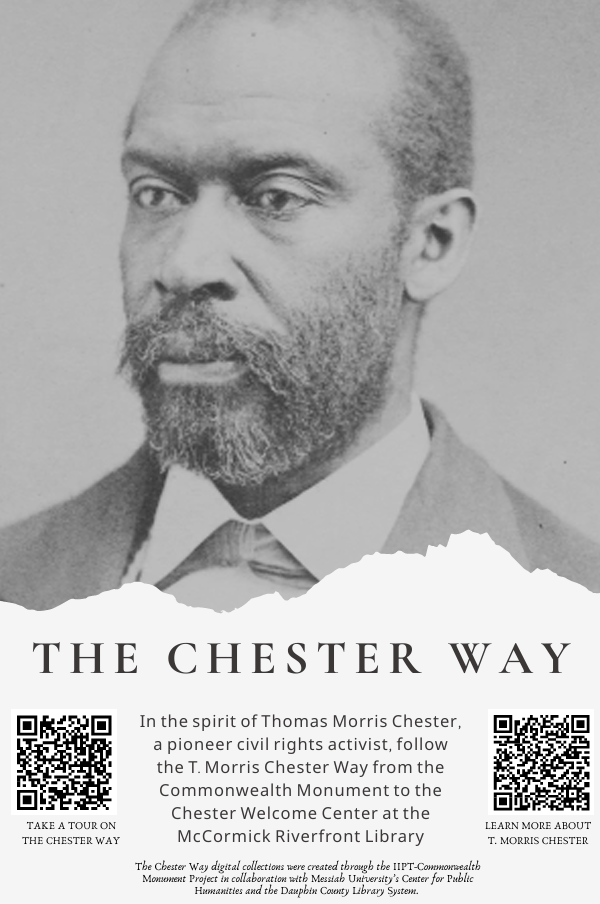
Throughout this semester, I have had the privilege to work on designing various yard signs for the “Gathering at the Crossroads” Monument in Harrisburg. In collaboration with Mr. Lenwood Sloan, Executive Director of the Pennsylvania Commonwealth Monument Project, I worked on creating two yard signs, the first pertaining to the Old Eighth Ward/Look Up, Look Out initiative and the second to T. Morris Chester and the “Chester Way”. Both posters can be seen below.
For those who may be unaware, “Look Up, Look Out” is an initiative of the IIPT-Commonwealth Monument Project and Messiah University’s Center for Public Humanities designed to promote better understanding and recognition of Harrisburg’s Old Eighth Ward. In addition, T. Morris Chester was the first African American war correspondent during the Civil War and a critical voice in the long quest for civil rights in the capital region. Messiah University’s Center for Public Humanities collaborated with the Commonwealth Monument Project and the Dauphin County Historical Society to recognize Chester’s influence and to build digital collections and physical collections related to Chester, Chester’s contemporaries, and African American and civil rights history more broadly.
To develop these two yard signs to promote these collections, I gained information through a meeting with Mr. Sloan on his vision and expectations. Since that meeting, I have used Canva to experiment, design, and access various templates and ideas for these two posters that capture the spirit of what they represent. After drafting several mockups of the posters, we met with Mr. Sloan to receive feedback.
Our goal was to prepare these signs to be displayed at the Commonwealth Monument on the south lawn of the Capitol Park by December 3. That date was chosen in conjunction with an event held at the Pennsylvania Capitol East Rotunda in remembrance of Chester’s contemporary, William Howard Day, who died on December 3.

These two posters seek to promote the history and multi-cultural voices of Harrisburg’s past. The Old Eighth Ward was a living space of African American, Jewish, and other immigrant communities who inhabited this area, until it was demolished during the early and mid-20th century. T. Morris Chester was a powerful voice who represented action, a fighting spirit, and deep historical remembrance of the region’s past. Both yard signs represent a renewed desire to seek out the voices and places of this region’s history and bring them into the modern day as inspiration, education, and hope.
The Look Up, Look Out yard sign has the portraits and life dates of Maude Coleman, Walter Hooper, Ephraim Slaughter, and Hannah Braxton Jones. In addition, there is also an image of modern Harrisburg on the one side and 20th century Harrisburg on the other. Along with a brief description of the Eighth Ward, a QR code links to resources and walking tours of the Capitol Park.

The Chester Way poster has the portrait of T. Morris Chester on it with two additional QR codes, one to his life’s “story map”, and the other to a civil rights walking tour of the capital district and the Harrisburg area.
The designing process was a true pleasure, and by the end I had 10 completed poster designs for the fellows, Mr. Sloan, and Dr. Pettegrew to select from. This semester allowed me to grow in ways of design and communication. This project also allowed me to see the wonderful work of the IIPT-Commonwealth Monument Project. Taking part in this work gave me a sense of mission to meet deadlines, help build bridges, and promote history for the capital region.
For me, these yard signs meant more than mere coursework; they allowed me to take part in a community initiative that supports the powerful voices of the past. It is these powerful voices that allow us in the present day to pay respect and continue to work for peace, and bridge building with all. Therefore, working with our own Dr. David Pettegrew, Mr. Lenwood Sloan, and our fellows, I am truly grateful.
Patrick Cosgriff is a senior psychology major at Messiah University who is working with the Center for Public Humanities and Digital Harrisburg Initiative in fall 2025.
 Digital Harrisburg
One thought on “New Yard Signs for the Commonwealth Monument (A Final Reflection)”