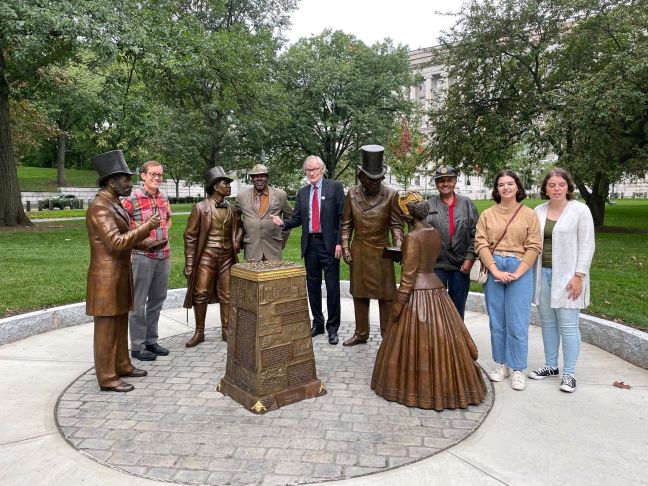
This article is the first in a series of posts of the Center for Public Humanities at Messiah University that highlights the voices of activists, educators, and community leaders in the Harrisburg area who are advancing civil rights and preserving history. With this initial post, we honor the late visionary, Lenwood Sloan, whose partnership with Digital Harrisburg and the Center for Public Humanities over the years deepened our work and profoundly impacted us. We name this series in his honor: The Lenwood Sloan Impact. See also Kelan Amme’s tribute to Lenwood, “Reflections on Equity, Parity, and Justice: The Impact of Mr. Lenwood Sloan.”
“Catalytic agents.” That is how the late Lenwood Sloan thought of himself and his friends, collaborators, and associates devoted to a common cause. I have a couple of thousand emails in my inbox sent by Lenwood over the last decade from an account with the handle “catalyticagents.” While Leni certainly described himself as a catalytic agent for change, I like to think that his use of the plural form here—agents—revealed his deeper vision for creating a community centered around storytelling, justice work, and the lifting of forgotten Black voices.
Lenwood died, unexpectedly, on December 26, 2025 at the age of 77, to the shock of his family, friends, and collaborators. Only two weeks earlier, I had the privilege of joining him at the East Rotunda of the State Capitol to honor William Howard Day, the brilliant Black educator, school board president, journalist, abolitionist, and civil rights pioneer of the 19th century. I briefly presented new yard signs installed at the Commonwealth Monument dedicated to the Eighth Ward and the Chester Way. Lenwood led the attendees in a version of the refrain from Ella’s Song: we who believe in freedom will not rest until it comes. A week before Christmas, I received an email from Leni (the last one, it would turn out) inviting myself and others to pause and remember December 18, 1865 when the abolishment of slavery became constitutional law. I have hundreds of messages like that one, urging us to recall pivotal moments and the lives of women and men whose courage raised the tide of justice for future generations.
As the catalyst for a series of initiatives, conversations, and projects related to African American history in Harrisburg, Lancaster, and beyond, Leni, in departing, has left gaps impossible to fill and legacies too large to curate. As a colleague of mine from the Commonwealth Monument Project put it, “It’s going to take hundreds and hundreds of feet to fill Lenwood’s shoes, and there will still be room in them. He left so many legacies. He lifted us in so many, many, many ways.” From the various tributes published to Lenwood in PennLive, The Burg, Lancaster Online, YMCA Lancaster, One United Lancaster, Pennsylvania Heritage Foundation, and The Irish Echo, you can pick up the sense of his wide-ranging energies and commitments to telling and reenacting the long history of civil rights in central Pennsylvania and beyond through projects, monuments, salons, exhibitions, public art, governmental events, convocations and conversations. The articles also convey the richness of Lenwood’s personality, character, gifts, and faith. He was a visionary, artist, historian, dancer, storyteller, charismatic, organizer, advocate, and leader. Gentle, humble, warm-hearted. “A wonderful human being after God’s own heart,” as Phyllis Bennet said.
Reflecting on our work through the Digital Harrisburg Initiative over nearly a decade, I cannot help but appreciate how Lenwood lifted and transformed our activities. He invited those of us involved with Messiah University’s Center for Public Humanities to build bridges between solid historical scholarship, demographic data, and primary sources, on the one end, and storytelling, remembrance, and commemoration on the other. He invited us to participate and cocreate with him on the Commonwealth Monument Project (for which he was executive director) and its fruitful products: the One Hundred Voices collections and book, the Look Up, Look Out poster exhibitions about the Eighth Ward, Harrisburg Historical’s civil rights tours, a public arts exhibition called Jubilee for Democracy, and story maps dedicated to Thomas Morris Chester and the Pennsylvania Past Players, among others. The faculty and educators who stepped into this invitation—Jean Corey, Andrew Hermeling, Katie Wingert McArdle, Peter Powers, Bernardo Michael, Sarah Myers (librarian), and myself, among others—are grateful for the transformative work that emerged from collaborating with Lenwood.
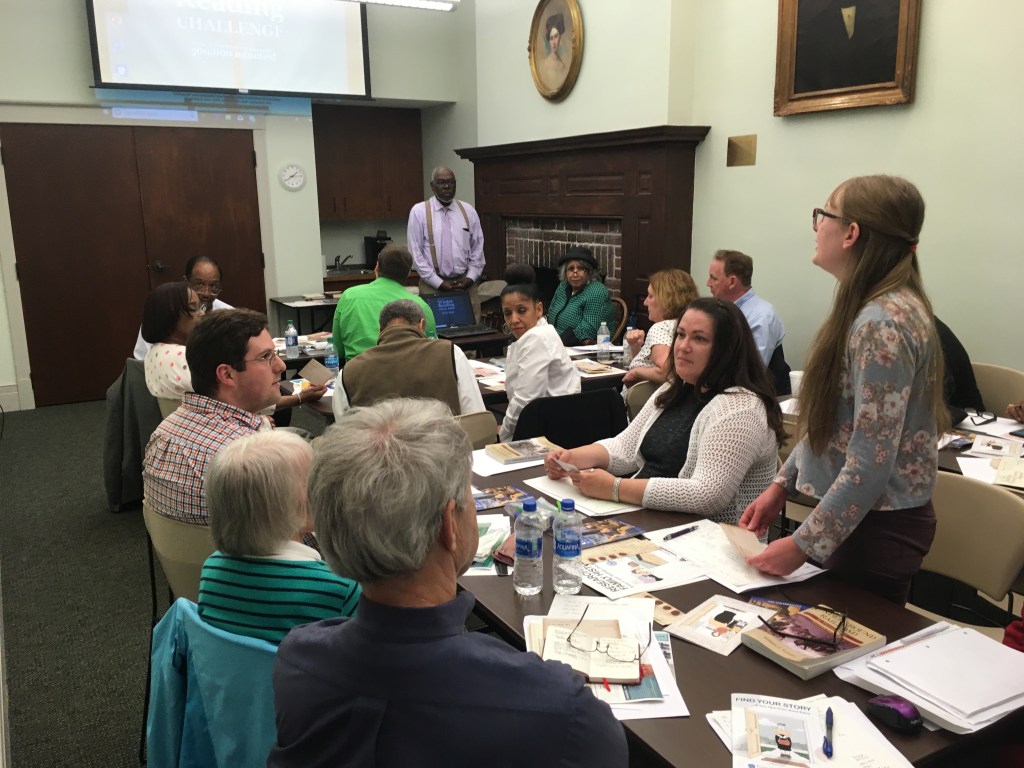
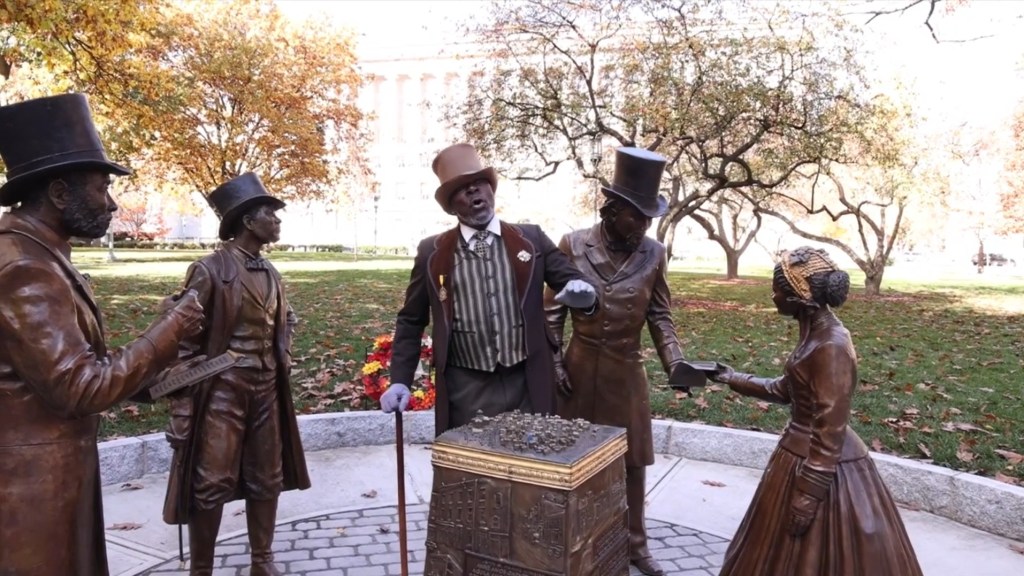
Well over a dozen times, I heard Lenwood tell the story of the genesis of the Commonwealth Monument Project that culminated in the dedication of the bronze monument group— “A Gathering at the Crossroads”—on state capitol grounds. He regularly began with the lost voices of the capital’s African American community. As he told the Burg Magazine in 2020: “As a Black historian, I’m always looking for the presence of the past. Where are the markers of the legacy of my people? Where are the symbols of our achievement against the odds? If you were born here, you might identify the few and vanishing markers of our heritage. If not, you’re lost. While working on a cultural project along the four-mile Riverfront Park, I could not find a single monument, plaque, bench or emblem of achievement exemplifying the contributions of African Americans. Walk the entire Capitol Complex, and you’ll find precious few markers promulgating our presence there either!” The recognition of neglect and erasure marked the seed of the energies that became the Commonwealth Monument Project. (You can hear Lenwood reflect on the Eighth Ward in this Spark interview from July 2025 with Aisha Tab and Dr. Andrew Hermeling).
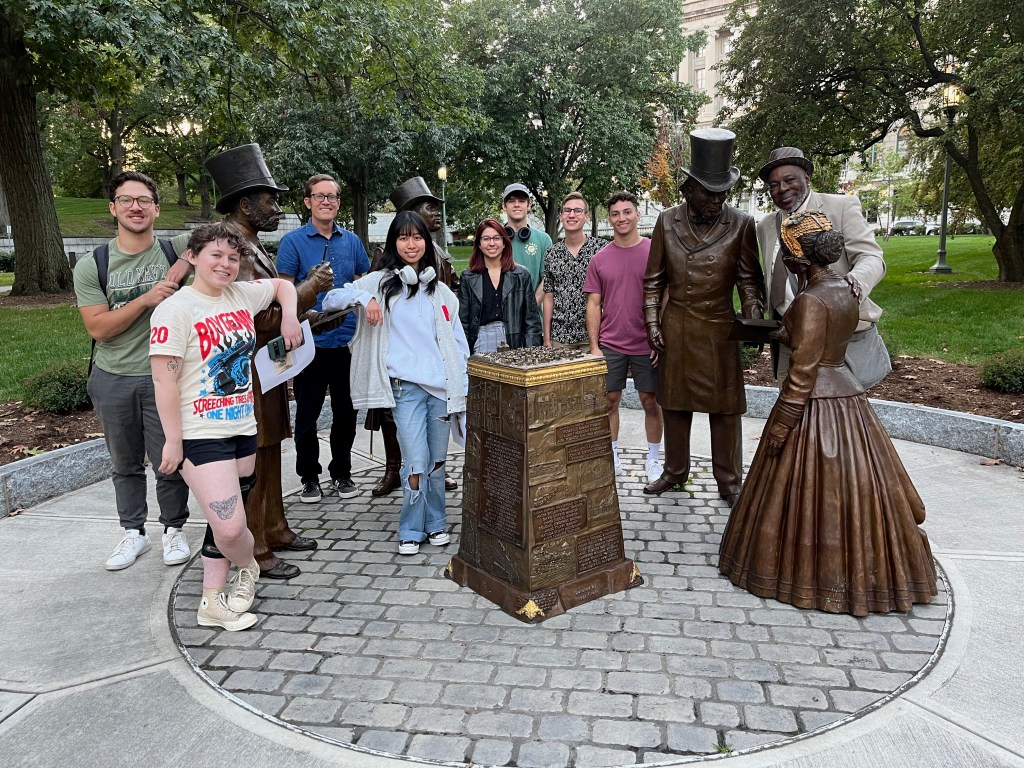
While Lenwood’s conversations and collaborations often led to specific products and outputs, I learned from him the importance of the convening itself. Digital humanists like myself often thought of the project we were working to finish, but Leni liked to remind me to put people first whether historical or living. In the Commonwealth Monument Project, the gathering of descendants of the Black community of the Eighth Ward was the whole point.
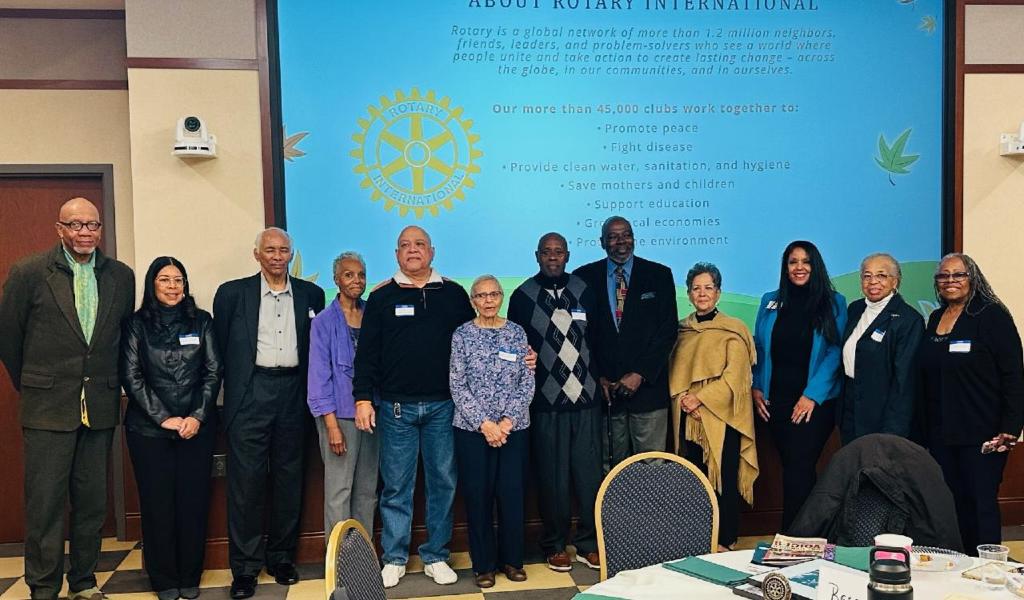
I myself am grateful for Lenwood’s interactions with dozens of my students and colleagues at Messiah University who met him through workshops, Chautauquas, Zoom meetings, and tours. I loved connecting students to Leni. He was kind, generous, spontaneous, and enthusiastic for intergenerational dialogue. He patiently encouraged our students to care about the often-forgotten legacy of African American history in central PA that had lasting impact on the wider world both past and present. He encouraged students to adapt language that dignified past agents— “Freedom Seeker,” not “runaway” or “fugitive,” for example, “enslaved,” not “slave,” “Black,” not “black”—and to carefully scrutinize the claims that an earlier age of journalists and writers made about African Americans in their day. A few students were fortunate to work closely with Lenwood, interviewing him on video, and producing short videos highlighting the Commonwealth Monument Project such as Lenwood performing Martin Delany at the Commonwealth Monument.
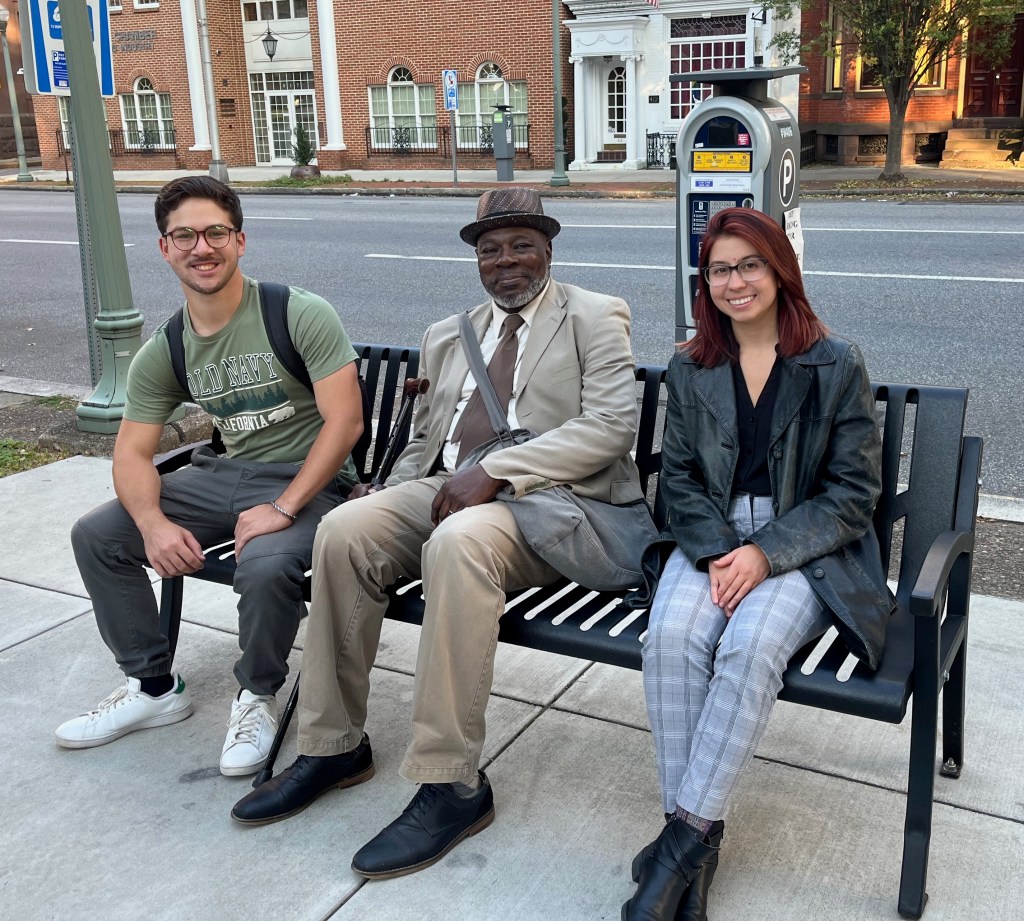
One former Messiah University student, Kelan Amme, who worked closely with Lenwood to produce a documentary (“Reimagining the Voices of Our Past”) about the Pennsylvania Past Players and the Dauphin County Library, remembered a “trial by fire experience” in working quickly with Lenwood to interview, edit, and produce. The experience became “one of the most meaningful partnerships” he could have imagined. Lenwood, he remembered, was “the catalyst for change in what it meant to be a public historian. He was inspiring, offering tough criticism and high expectations…. He was also patient and accepting, working with every situation with the understanding that there would be a shared outcome we could all agree upon.” (We will post Kelan Amme’s full reflection next week).
My colleague, Pete Powers, who directs Messiah’s Center for Public Humanities, noted Lenwood Sloan’s impact in this way: “I can’t let the moment pass without recognizing how important Lenwood was to the education of our students at Messiah University, especially our public humanities fellows….It is, perhaps, not fully recognized enough how much public humanities projects like Digital Harrisburg or Harrisburg Historical are collaborative projects that depend upon the generosity of the community in helping students and faculty discover, interpret, and disseminate new knowledge about the history and culture of our community. For Lenwood’s leadership role in all that and for the education he provided for our students, and for me, I will be always thankful….In so many ways, both in his art and in his life, Lenwood embodied and brought to life African American history and culture for the purpose of the common good.”
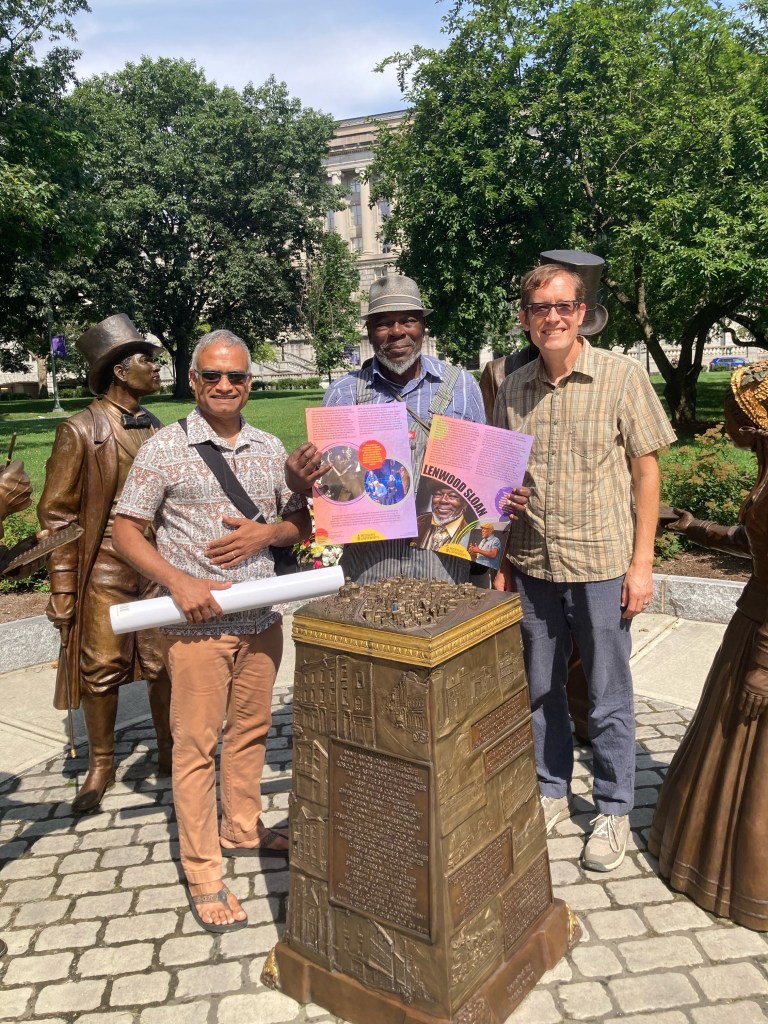
Another colleague, Bernardo Michael, who came to know Lenwood through collaborative projects, common conversations, and interviews, reminded me of a poster he and students produced about Lenwood celebrating him as an “artivist,” who “combined a passion for theater, film, and dance with prophetic historical insight to create storytelling projects of lasting civic value.” The poster concluded that his various work marked “a powerful testimony to how creative imagination and a tireless commitment to equity and inclusion can redress the injustices of the past and help nurture communities to health and wholeness.” Bernardo himself noted that he used his performative gifts “to heal the brokenness in our world. He lived a story of reconciliation.” The poster produced for Messiah University’s Intercultural History Project, Community Engagement Series (2024) is visible below.
Another colleague, Andrew Hermeling, who collaborated closely with Lenwood on the “Look Up, Look Out” project, remembers one specific phrase as the key to Lenwood’s vision. As Andrew recalls, “anyone who worked with Lenwood closely would eventually hear him say ‘Let me go backwards to go forward,’ when he felt something needed more historical context to fully understand its meaning and weightiness. But this phrase also encapsulated everything he stood for. The change he sought to bring about in the present through public humanities work was built on deep historical understanding. In other words, we as a nation and a society could not move forward without first stepping backwards into our shared past. As someone who had the immense joy of collaborating with Lenwood, I cannot think of a better epitaph for such an immensely impactful catalytic agent.”
I myself will miss Lenwood’s collaborative spirit and persistent impetus to raise individual talents to give voice to the voiceless of the past. A few years ago, as I was putting together a presentation on collaboration in public humanities projects, I reached out to Leni about what makes project-based collaboration both good and generative. I considered him a good collaborator. In his list of best practices, he named “common causes,” “shared vision,” “co-creativity,” “open dialogue for conflict/resolution,” and “kindred spirits!” (yes, with that exclamation point). Lenwood embodied all of these, of course, to the good of many.
Thank you, Lenwood, for inviting us into the catalytic work of justice and transformative storytelling—and for reminding us that when we work together using the gifts given us by God’s creative hand, even mountains can move. You also reminded us that each of us, through love of neighbor, can become a catalyst for something more.
“I never had a single concern about tomorrow,” Lenwood wrote. “I am only concerned with ‘did I make something better for someone today?’ If not, I will start again tomorrow.”
May we do the same.
David Pettegrew, writing on behalf of Messiah’s faculty, students, and alumni who were touched by our transformative work with Lenwood over the years. Thanks to Peter Powers, Bernardo Michael, Kelan Amme, Sarah Meeks, Faith Snyder, and Andrew Hermeling for contributing to this reflection. David Pettegrew is Professor of History and Archaeology, and Coordinator of Digital Humanities at Messiah University.
 Digital Harrisburg
3 thoughts on “Catalytic Agents: The Lenwood Sloan Impact”