
A business major might tell you that trading two quarters for one is a bad deal, but I’ve done it when I needed the one quarter for a collection. I collect coins from the 50 State Quarters Program, the America the Beautiful Quarters Program, and the American Women Quarters Program. A survey conducted by the United States Mint in May 2005 while the state quarters were still being released shows that I’m not the only one. At the time, about 147 million people were collecting the state quarters.
But the 50 State Quarters Program was about more than just convincing people to collect quarters. The US Mint’s other official goals in the ‘‘50 States Commemorative Coin Program Act’’ were to honor the states, make money for the US Treasury, and educate people on what their state represents. Released on March 8, 1999, the Pennsylvania state quarter design features a keystone, the state outline, and the state motto. The main focus of the quarter is the statue Commonwealth by Roland Hinton Perry that sits on top of the state capitol building’s dome.

Figure of the statue Commonwealth on the dome of Harrisburg’s capitol building (photo by Carol M. Highsmith on Rawpixel)
In the months before this design was chosen, many people submitted ideas and artwork as nominations, including entire classes of students. The ones housed in the Pennsylvania State Archives include emails, school worksheets, letters, index cards, postcards, a poster, and pieces of art. Among the nominations were appeals to Pennsylvania’s history, famous products, state symbols, and more. They included suggestions for the keystone symbol, an outline of the state, and the state motto, yet none of the submissions I saw in the State Archives mentioned Commonwealth.
I turned to the Dauphin County Archives to research the statue and attempt to figure out why it is featured on our state quarter. I digitized documents on Commonwealth, including handbooks, several drawings of the capitol building, a souvenir book, and some brochures. My favorite discovery was a Bible from 1895 that survived the fire that destroyed the old capitol building on February 2, 1897. This led to the construction of the current capitol building onto which Commonwealth was installed on May 25, 1905. When in an archive, the unexpected finds like this are the most intriguing, but the very act of visiting an archive is an interesting experience.
My visits to the state and county archives were part of a Digital History course at Messiah designed to give us the opportunity to research and digitize documents in an archive. For me, that meant using the camera and Notes apps on my phone and a CZUR scanner to scan pictures. Both archives had lantern slides that I took pictures of, but while I could use a light box at the State Archives, there was not one readily accessible at the County Archives, so I improvised with the ceiling lights. Improvising is a major part of doing history, especially in a digital age. I tried to take good pictures of all the sources I digitized because I might want to make any of them available to the public and I wanted to have that option without having to return to the archives. A clear picture allows a text’s information to be accessible to the public, even for texts that are not necessarily high priority for the public or researchers.


Figure of a lantern slide showing a sketch of the newly built Pennsylvania capitol building from the Dauphin County Archives (photo by author)
Digitization prioritization is an idea that digital humanities scholar Adam Crymble discusses as something archivists have to consider. When it came time to decide what they should digitize first, archivists had to ask questions about whose voices they were prioritizing and whose voices were being left out of the process. There is not a lot of information about the Pennsylvania state quarter competition on the internet. While this probably means that not many people are inherently interested in the competition and the statue Commonwealth, millions of people have collected the state quarters so approaching it from that angle may generate more interest. Also, most people would not go to the archives to read about the Pennsylvania quarter but may enjoy learning about it if it is more readily accessible online.
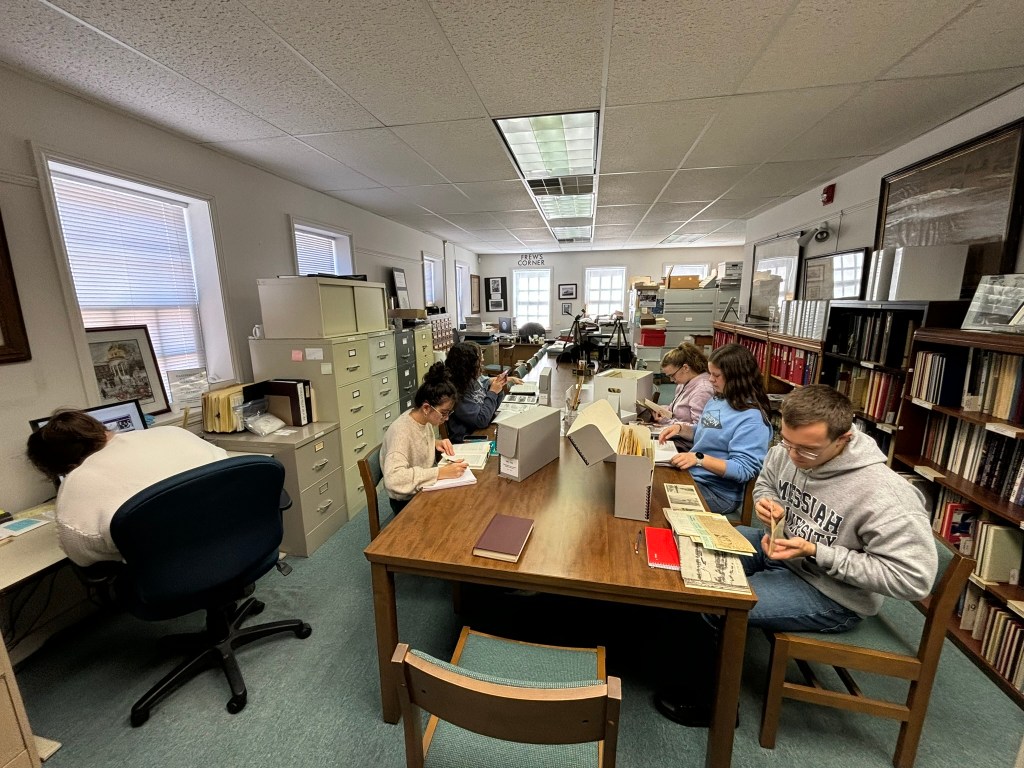
Figure of Messiah University students working at the Dauphin County Archives (photo by David Pettegrew)
A clear benefit of digitizing sources from archives is making them available to the public, but it can also generate questions that cause more research and raise questions about text priorities. While it may not be a priority to many historians, I hope to digitally tell the story of the Pennsylvania state quarter to appeal to amateur quarter collectors like me. The story I share of its development will center around the statue Commonwealth that is prominently featured on both my state’s quarter and its capitol.
Emmy Varner is a senior at Messiah University. She is majoring in public history and minoring in creative writing and education.
 Digital Harrisburg